

A laboratory with vineyards.
Jean Ribéreau-Gayon
Almost a third of the vines we harvest today he planted himself.
What an oenologist does with a wine estate.
Jean Ribéreau-Gayon was a chemist and professor; the profession called him the "father of modern oenology". In 1938 he bought the Domaine aux Conseillans and turned it into his experimental estate: wine was made in the fermentation cellar, and the laboratory lay in the passage behind it. In his early years Émile Peynaud worked here too, later becoming one of the most renowned oenologists in the world. The estate remained in the family until 1996, then passed into other hands; since 2023 we have carried it on as LaSuite aux Conseillans. The vines he planted in 1953 still bear fruit today — their grapes flow into the wines of LaSuite aux Conseillans.
- 1938
- Jean Ribéreau-Gayon buys the domaine
- 8,646
- vines from 1953, planted by him
- 1963
- Founding of the Institut d’Œnologie
His dates and work are recorded in the catalogues of the Bibliothèque nationale de France and of IdRef; his activity at the domaine is documented by contemporary press (Sud-Ouest, La Journée Vinicole, Revue française d'Œnologie, 1991) and official records.
Last updated: August 2026

Ulysse Gayon
The line begins in the 19th century with Ulysse Gayon, a student of Louis Pasteur. He brought laboratory science into winemaking and helped develop the Bouillie Bordelaise, the copper-lime mixture that saved Europe's vineyards from downy mildew. Gayon did not live on the domaine, yet his conviction — that quality arises from microbiological understanding — became the foundation on which his grandson built here.

Jean Ribéreau-Gayon
He was a grandson of Ulysse Gayon and one of the fathers of modern oenology. Our tasting room today was his fermentation cellar, with the laboratory in the passage behind it; we have kept the press, concrete vats and utensils from that time.
He used his experimental cellar here at the domaine for his work on fermentations — among them malolactic fermentation (MLF), which he described together with the young Émile Peynaud. In it, the hard malic acid is converted into softer lactic acid, giving many great red wines their rounded suppleness; today this is standard for most red wines in the world. How it works is explained in detail in the context article What malolactic fermentation does; the short definition can be found under malolactic fermentation. Professionally, he took over the direction of the Station agronomique et œnologique in 1949, founded the École supérieure d'œnologie in 1957 and, in 1963, shaped it into the Institut d'Œnologie of the University of Bordeaux.
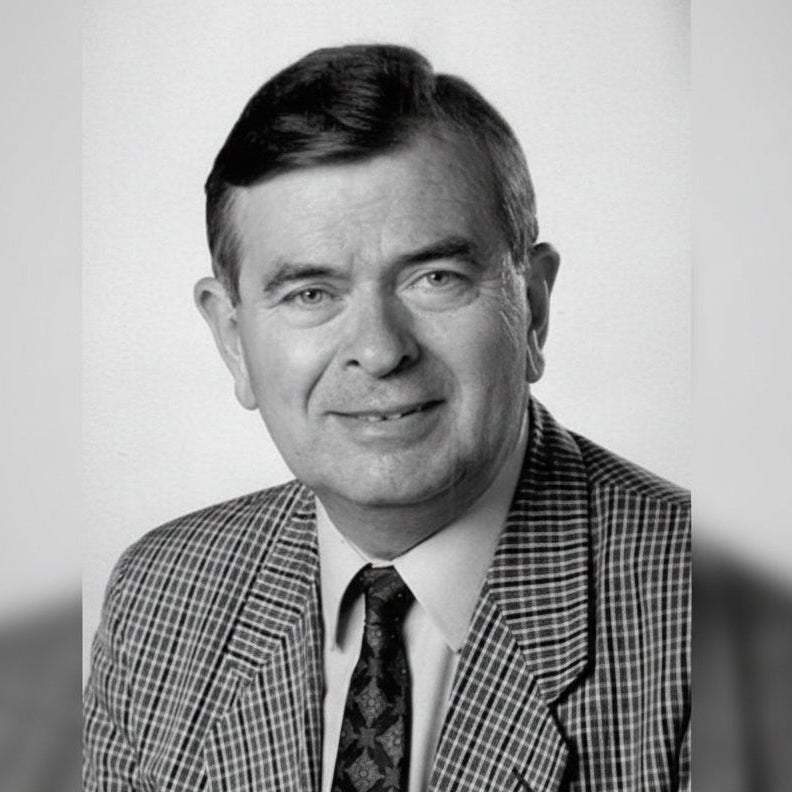
Pascal Ribéreau-Gayon
His son Pascal Ribéreau-Gayon carried the work forward and directed the Institut d’Œnologie in Bordeaux for nearly two decades. As one of the authors of the Traité d’Œnologie, a standard reference to this day, he shaped the understanding of phenols and tannins — and of when tannins are ripe enough to feel soft rather than hard. Among his students were oenologists such as Denis Dubourdieu and Michel Rolland.

The vines he planted.
In 1953 Jean Ribéreau-Gayon set 8,646 vines: Merlot, Cabernet Franc and Côt, across six parcels on 1.67 hectares. They are all still standing and still bearing.
Old vines yield little, and we harvest them parcel by parcel because we want to see what each one gives on its own. What this family researched is still in the decisions we make in the cellar.
Frequently asked.
Is the Domaine aux Conseillans the same estate where Jean Ribéreau-Gayon carried out his research?
Yes. He bought the estate in 1938 and shaped it as its owner; it remained in the family until 1996. Today's tasting room was his fermentation cellar, with the laboratory in the passage behind it. Since 2023 we have carried the domaine on as LaSuite aux Conseillans.
What did Jean Ribéreau-Gayon discover?
Together with Émile Peynaud he described malolactic fermentation — the conversion of malic acid into lactic acid, which makes red wines softer. Today it is standard for most red wines in the world. Professionally, he took over the direction of the Station agronomique et œnologique in 1949, founded the École supérieure d'œnologie in 1957 and, in 1963, shaped it into the Institut d'Œnologie of the University of Bordeaux, which carried these findings into practice.
What remains today from Jean Ribéreau-Gayon's time on the domaine?
We have kept the old press, concrete vats and laboratory utensils — together with the experimental cellar where Émile Peynaud once worked too. And 8,646 vines he planted in 1953: six parcels of Merlot, Cabernet Franc and Côt. They are harvested separately and fermented separately, like all the parcels of the Domaine aux Conseillans, so that we can see what each one gives on its own.
Is the estate protected?
Yes. In 1975 the Domaine aux Conseillans was placed under state protection as a "Site classé" — at the instigation of Jean Ribéreau-Gayon himself. Protected are the late-18th-century chartreuse and the park with its old, in part rare trees, among them great cedars.
Who discovered malolactic fermentation?
The phenomenon was already observed in the 19th century. Its oenological significance and its deliberate control were worked out in Bordeaux by Jean Ribéreau-Gayon and his student Émile Peynaud — partly here at the Domaine aux Conseillans. How it works is explained in the context article.
Read on.
Where this science sits in the decisions we make today — and where it has remained visible on the domaine.
From this legacy comes what stands in the glass today.