

Five hectares within nineteen.
Discover boutique Bordeaux
The rest is woodland, meadow and water, protected since 1975.
What a boutique Bordeaux is
A boutique Bordeaux comes from an estate that farms its own vines, raises the wine itself and bottles in small quantities. In our case that is five hectares of vines, where every bearing parcel is fermented on its own; only afterwards does the tasting decide which barrels form a cuvée.
- 5 ha
- of vines within a 19-hectare estate
- 16
- parcels, 14 of them bearing
- 324
- bottles of Prélude 2023
The estate's vineyards are certified organic and HVE4; the property has lain within a state-classified protected area (Site Classé) since 30 December 1975. Target yield 45 hectolitres per hectare.
Last updated: July 2026

Forty-five hectolitres per hectare, no more.
Five hectares at that target yield settle the quantity before the vintage even begins. Every bearing parcel is picked separately and fermented separately, sixteen small lots instead of one large cellar.
Most of the estate is not under vine anyway. On the south-facing slopes at eighty metres stand 28,929 vines: a few still from 1938, the greater part from 1953, along with plantings from the nineties. There is no irrigation; for plant health a drone flies here, one of only fifteen wineries in the Bordelais permitted to do so.
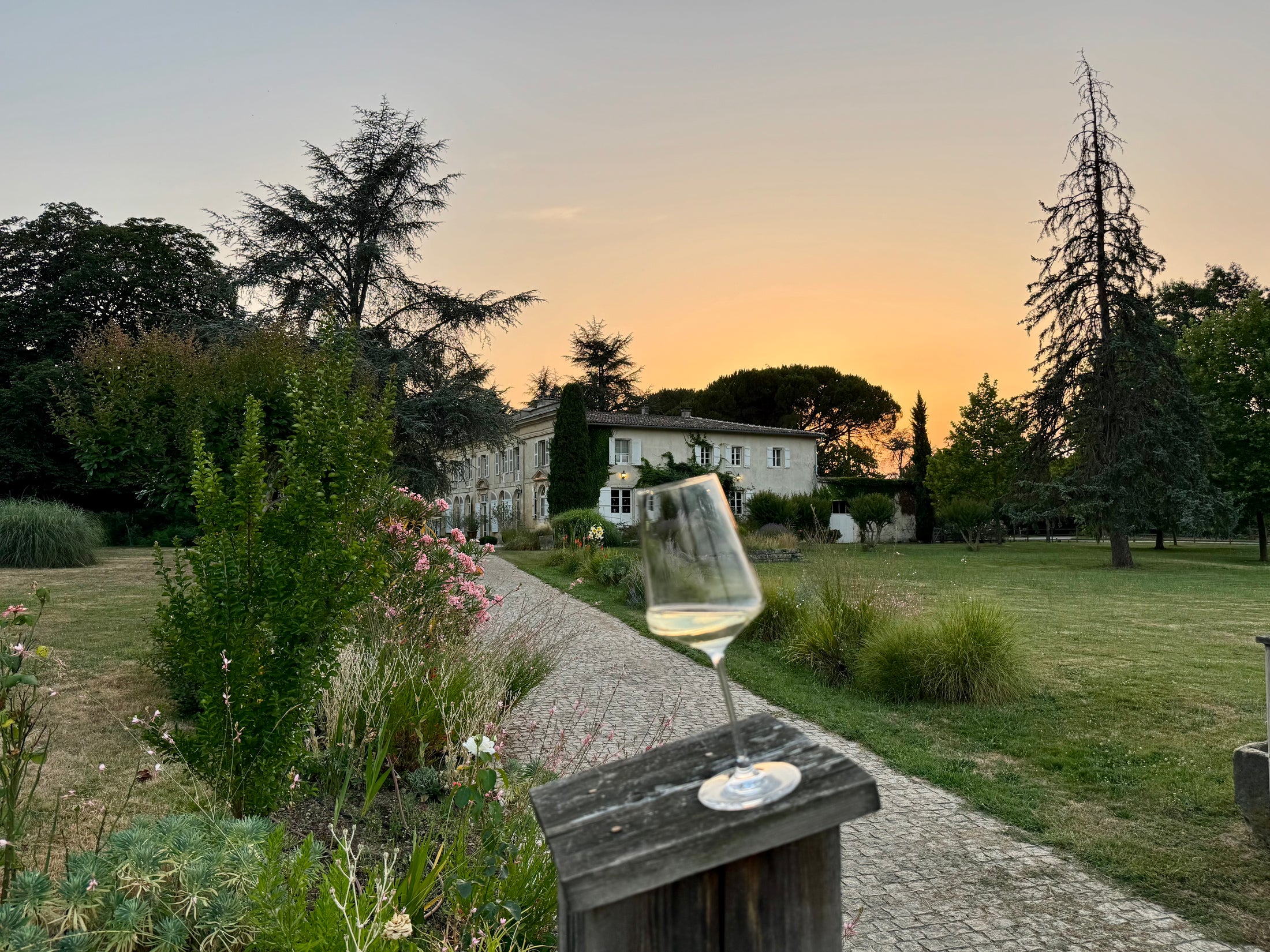
In 2024 there was no Caprice at all.
The cuvées stand side by side as equals, like the movements of a suite — hence the name. Ellen is a concert pianist; in summer there is music here, for small gatherings. Not every movement is available at every moment: 101 bottles of Caprice 2023 were filled, and the year after there was none at all. A vintage that has been drunk does not come back.
In return, no bottle leaves the estate until we would happily drink it ourselves. To get to know the wines, the Coffret Dégustation brings three movements of the suite together: Sarabande 2015, Gigue 2016 and Louré 2024.

An estate shaped by an oenologist.
The Ribéreau-Gayon family owned the domaine from 1938 to 2002; Jean Ribéreau-Gayon, co-founder of modern oenology, shaped it as its owner over decades. After two further owners, we took over in 2023. Depending on the wine, ageing takes place in barriques, clay amphorae and concrete; the Allemande, which we press only in strong vintages, lies more than thirty months in barrel and is released only when it is ready.
Frequently asked.
Why is there so little of some wines?
Because we taste first and decide afterwards. Only barrels that belong together go into a cuvée; the rest finds another place, up to being sold as bulk wine. With five hectares and 45 hectolitres per hectare, not much is left after that — for the Caprice in 2024 it meant no bottling at all.
What is the best way to get to know an estate of this size?
With several bottles in one evening. One white and two reds from the same estate say more about the signature than three vintages of the same cuvée: you can hear what comes from the making and what comes from the year. Tasted singly, that is harder to grasp.
Where is the estate, and which appellation is on the label?
At the Domaine aux Conseillans, on the right bank of the Garonne just outside Bordeaux, on south-facing slopes at eighty metres. The red wines carry the AOC Cadillac / Premières Côtes de Bordeaux, the rosé Bordeaux Rosé, the dry white Bordeaux Blanc; the Caprice, an Alvarinho, stands outside these appellations as Vin de France.
Read on.
How the yield comes about, why there is not a Caprice every year, and what the suite has to do with music.
An estate this size is understood in the glass.